
Biodiversity, Demography, and Habitat Use
Woodland sites are equipped with biodiversity stations, which have acoustic recording devices and camera traps to passively capture the activity of mammals and birds in all treatments. Understanding the impacts of treatments on wildlife will provide managers with much more confidence on how their treatments influence the biodiversity of the system.
Demography and Habitat Use of Song Birds
Songbirds are of keen interest because sage-obligate species are considered to be especially at risk of habitat loss and subsequent population declines given the rapid habitat changes now occurring in sagebrush steppe ecosystems. Species richness and diversity, and productivity of songbirds are being evaluated across a suit of species that breed in habitats along a woodland invasion gradient. A combination of point counts and acoustic recorders are being used across the SageSTEP woodland network to study species richness and density in relation to treatment, weather, and vegetation composition.
Species Richness and Treatment Impacts on Ants, Beetles, Spiders, and Butterflies
Arthropods in sagebrush steppe ecosystems serve as scavengers, predators, symbiotic partners of other invertebrates, predators and dispersers of seeds, and as prey for a wide array of vertebrates, including many sage-obligate birds. We are evaluating species composition and relative abundance and treatment impacts on ants, beetles, spiders, and butterflies. Since arthropod species differ markedly in the ecological roles they play, and these roles are generally well known for sagebrush species, we will be able to understand how management treatments alter the balance between roles over time.


Latest Resources on Wildlife
View article.
Epigaeic (ground-active) spiders are dominant predators of arthropods and are important prey for vertebrates in sagebrush steppe systems. As part of the Sagebrush Steppe Treatment Evaluation Project (SageSTEP), the response of epigaeic spiders to sagebrush steppe restoration treatments was evaluated. Spiders were pitfall trapped pre-treatment and for up to 7 years post-treatment at 20 sites in the interior western United States. Spider species, functional groups, and communities were analyzed as regards site conditions and in response to treatments (prescribed fire, mechanical, and herbicide) designed to restore sagebrush steppe lands encroached by piñon–juniper woodlands and invaded by cheatgrass. A total of 10,149 epigaeic spiders were caught during the 8-year sampling period (2006–2014), comprising 18 families, 51 genera, and 109 species. Ten species are currently undescribed, including two species of jumping spiders (Salticidae), two species of funnel spiders (Agelenidae), and a species of trapdoor spider (Euctenizidae). Nearly 70% of adult catch comprised the 10 most commonly collected species; 50 species were caught fewer than five times. Spiders of the family Gnaphosidae (ground spiders) dominated the collection (65% of adults), followed by wolf spiders (Lycosidae; 12%), jumping spiders (8%), and crab spiders (Thomisidae; 4%). Fewer gnaphosids were caught in plots with higher tree cover, and this pattern was reversed by tree removal. There was no significant epigaeic spider response to the broadleaf herbicide tebuthiuron, nor to mowing or clear-cutting. Mastication caused a subtle increase in epigaeic spider richness at Utah juniper sites. Prescribed fire decreased abundance and richness of epigaeic spiders in the short term (1 year post-treatment), with catch at most sites converging to control levels by Year 2 post-treatment; application of the annual herbicide imazapic at treeless sites may have amplified this effect slightly in the short term. In general, gnaphosid catch and richness closely paralleled litter and bunchgrass cover. These patterns suggest that while gnaphosid spiders are not sagebrush-obligate species per se, these spiders prefer habitat conditions that provide more hiding cover, in the form of litter and vegetation, found more often in treeless sagebrush steppe plant communities and in woodland communities that have relatively lower tree cover.
View article.
We used structural equation modeling to develop and statistically test our conceptual model that the current bird assembly at a site is structured primarily by the previous bird community with additional drivers from current and surrounding habitat conditions as well as external regional bird dynamics. Treatment reduced woodland cover by >5% at 80 of 378 survey sites. However, habitat change achieved by treatment was highly variable because actual disturbance differed widely in extent and intensity. Biological inertia in the bird community was the strongest single driver; 72% of the variation in the bird assemblage was explained by the community that existed seven years earlier. Greater net reduction in woodlands resulted in slight shifts in the bird community to one having ecotone or shrubland affinities. However, the overall influence of woodland changes from treatment were relatively small and were buffered by other extrinsic factors. Regional bird dynamics did not significantly influence the structure of local bird communities at our sites. Our results suggest that bird communities in piñon-juniper woodlands can be highly stable when management treatments are conducted in areas with more advanced woodland development and at the level of disturbance measured in our study.
Restoration of sagebrush ecosystems through removal of pinyon-juniper woodlands is in full swing across much of the Intermountain West—reclaiming sagebrush where pinyon juniper expansion has occurred due to lack of fire and more precipitation during past climatic cycles. This practice has measurable benefits including restoration of habitats and connectivity for greater sage-grouse and other sagebrush obligate species. But in the larger complex ecological system across the Great Basin, there can inevitably be unintended consequences for any management action. One potential consequence in the balance is the pinyon jay (Gymnorhinus cyanocephalus) (Figure 1). This bird’s population declined by a startling 85% between 1970 and 2014, according to Partners in Flight. The group estimates that if the current rate of decline continues, pinyon jays will lose another half of their remaining population by 2036. Pinyon Jays occur across a large expanse of the west including the Great Basin primarily in the southern and eastern half.
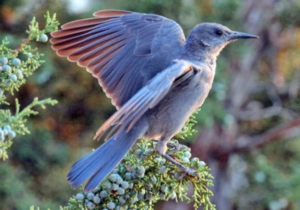
Figure 1. Pinyon jay on a fruiting pinyon branch.
Pinyon jays present both a conservation challenge and a paradox. While the species has declined, its preferred habitat (pinyon-juniper woodlands) has expanded, and in some areas to a large extent. It seems that population declines are not a function of reductions in habitat amount, but are related to changes in habitat quality. Up to now research on the species has been paltry, and so details about the trend have only recently begun to surface.
“Factors that are driving the Pinyon Jay population decline are still a bit of mystery,” said Patrick Magee, jay researcher at Western State Colorado University. But it seems that the species’ decline involves changes in the age and structure of pinyon-juniper woodlands, he said. Pinyon jays prefer a mixed-age mosaic of woodland interspersed with sagebrush shrubland. Although they roost and nest within relatively dense groves of older trees, they typically locate their nests usually within half a mile of the habitat edge. The large expanses of homogenous closed-canopy pinyon-juniper woodland that have become more common over the past century are largely unsuitable for the birds.
To further cement their complex fate, pinyon jays depend on caching pinyon pine nuts. The jays make heavy use of pine nut crops early to late fall, and mainly rely on these seed caches along with other food sources over the rest of the year. Seed caches are usually located in the woodland-shrubland transition zone, or in pure shrublands within 3 miles of the woodland edge.
This caching strategy and preferred nesting sites ties these birds to a complex, “shaggy” edge of a pinyon juniper woodland. This structure typical of mixed-age woodlands with shrub openings and a complex habitat edge are what pinyon jays prefer and what continues to decrease.
Management activities within pinyon-juniper woodlands over the last six decades have primarily focused on tree removal to increase forage for wildlife and livestock, and more recently on fuel reduction and GRSG habitat objectives. Mastication and thinning strategies, to this point, have had an adverse impact on the pinyon-juniper/sagebrush transition zone that Pinyon Jays and many other species need. While these treatments are widely accepted as cost-effective means of meeting short-term management goals, a considerable amount of uncertainty remains about the long-term impacts on species composition for pinyon-juniper obligate species like the pinyon jay.
Land managers have an opportunity to make pinyon-juniper treatments compatible with the habitat requirements for a multitude of species such as pinyon jays. For example, treatments are planned on a project-by-project scale, so the overall picture of impact on pinyon jay populations may be missed. A move to landscape-scale priority planning for tree-removal treatments could help align proposed projects with pinyon-juniper stands where pinyon jays will not be impacted. Treatments can incorporate elements that benefit pinyon jays such as: avoid creating sharp habitat edges between reclaimed sagebrush and closed-canopy woodland; incorporate a mixed-edge or convoluted edge treatment strategy; retain a mosaic of large areas of open and mixed-age woodland habitat; retain cone-bearing trees; and avoid disturbance within 0.6 miles from known nesting sites and colonies. These elements will also benefit many other species that depend on this transition zone (e.g. mule deer) and mature pinyon-juniper woodlands.
If removal of pinyon-juniper woodlands remains a priority for land managers, we need to develop management strategies that benefit a multitude of species occurring in the Great Basin and help mitigate impacts on the pinyon jay before it becomes a crucial “sage grouse-like” issue. With the amount of treatment planned in the near future by land managers, it could become a major problem.
“Birds respond to pinyon-juniper thinning treatments in complex ways. You can’t generalize how the bird community will react to a particular treatment,” said Magee. “Each species behaves in its own way and even within a species the response could be complex. Pinyon Jays may benefit if woodland thinning is done in a way that creates more foraging habitat, but simultaneously they may decline when the same thinning reduces nesting cover. Management needs to move into more nuanced approaches, there’s no one-size fits all restoration treatment for the whole pinyon-juniper bird community.”
But if PJ removal is detrimental for the pinyon jay, it may still be better than allowing woody fuels to build up and result in large wildfires, making large areas unsuitable for jays. Mechanical tree removal projects could be designed to reduce woody fuels and leave selected habitat areas for the pinyon jays.
“Pinyon-juniper thinning treatments represent a challenging land management balancing act between competing ecological values, especially at the interface of sagebrush and pinyon-juniper ecosystems, and social and economic values. Avian species conservation requires innovative and nuanced approaches that encapsulate the complexity of the system,” Magee said.
This field note written by Lael Gilbert.
References:
Ammon, E. M., and J. D. Boone (2014). Long-term declines in Pinyon Jays as a function of landscape changes. Presentation at the Western Field Ornithologists’ Conference, Great Basin Observatory, San Diego, CA, USA.
Balda, R. P. 2002. Pinyon jay (Gymnorhinus cyanocephalus). In The Birds of North America, No. 605 (A. Poole and F. Gill, eds.). The Birds of North America, Inc., Philadelphia, PA.
Coop, J.D., and P.A. Magee. Integrating Fuels Treatments and Ecological Values in Piñon-Juniper Woodlands: Fuels, Vegetation, and Avifauna. Final Report to the Joint Fire Science Program. 2016. Agreement number L13ACOO23.
Great Basin Bird Observatory. http://www.gbbodata.org/pdf/bcp/63_Pinyon%20Jay.pdf
Johnson, K., T. B. Neville, J. W. Smith, and M. W. Horner. 2016. Home range- and colony-scale habitat models for Pinyon Jays in piñon-juniper woodlands of New Mexico, USA. Avian Conservation and Ecology 11(2):6. http://dx.doi.org/10.5751/ACE-00890-110206
Partners in Flight. 2016. http://pif.birdconservancy.org/ACAD/Database.aspx
Rosenberg, K.V.; J. A. Kennedy, R. Dettmers, R. P. Ford, D. Reynolds, J.D. Alexander, C. J. Beardmore, P. J. Blancher, R. E. Bogart, G. S. Butcher, A. F. Camfield, A. Couturier, D. W. Demarest, W. E. Easton, J.J. Giocomo, R.H. Keller, A. E. Mini, A. O. Panjabi, D. N. Pashley, T. D. Rich, J. M. Ruth, H. Stabins, J. Stanton, T. Will. 2016. Partners in Flight Landbird Conservation Plan: 2016 Revision for Canada and Continental United States. Partners in Flight Science Committee. 119 pp. 2016. http://www.partnersinflight.org/wp-content/uploads/2016/08/pif-continental-plan-final-spread-single.pdf
Sauer, J. R., J. E. Hines, J. E. Fallon, K. L. Pardieck, D. J. Ziolkowski, Jr., and W. A. Link (2014). The North American Breeding Bird Survey, Results and Analysis 1966 – 2013. Version 01.30.2015. USGS Patuxent Wildlife Research Center, Laurel, MD, USA.