
Soils and Biogeochemistry
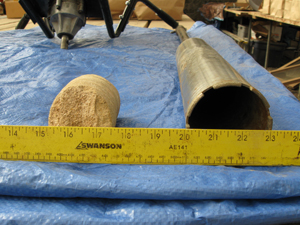
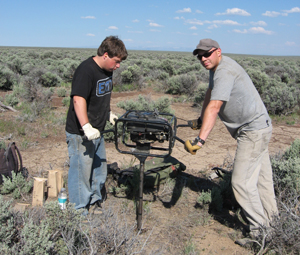
We expect that plants may respond differently to land management treatments due to soil differences at various research sites. We expect that treatments and changes in vegetation composition and abundance could also result in changes to soil properties, such as soil carbon storage, moisture availability, infiltration, etc. Past and future soil sampling will help explain these differences in treatment outcomes and long-term dynamics.
The data provided by these samples is used to:
• identify abiotic factors that influence vegetation distribution and site recovery following management treatments, including moisture retention and release;
• complete ecosystem carbon and nitrogen budgets for semi-arid systems and land management treatments;
• identify drivers of infiltration, runoff, and sedimentation processes.
Latest Resources on Soils
View article.
Effective hydraulic conductivity (Ke) is an important parameter for the prediction of infiltration and runoff by the Rangeland Hydrology and Erosion Model (RHEM). Three sets of equations to predict Ke have previously been used in RHEM. These equations are mainly based on rainfall simulation data representing undisturbed sites and have not undergone comprehensive evaluation for various rangeland conditions, particularly after disturbances. The goal of this research was to evaluate these equations using independent data obtained from rainfall simulations conducted at multiple rangeland sites. Additionally, we developed and evaluated a new set of Ke predictive equations applying readily measurable cover and soils data spanning a wide range of vegetation, soil textures, and disturbance conditions. The results show that all previous Ke equations in RHEM have a “satisfactory” performance with index of agreement (d) > 0.75 and R2 > 0.4. The new Ke approach resulted in “very good” performance with d > 0.9 and R2 > 0.5. The new set of equations enhances RHEM for applications over broader rangeland conditions, including sparse vegetation cover following disturbances or community transitions.
View article.
Over the past century, pinyon and juniper trees have encroached into sagebrush steppe lands of the interior United States, and managers have for many years removed trees to stimulate the favored understory. While consistent understory response to tree removal in these semiarid lands suggests that trees outcompete other plants for water, no studies have linked increased soil water to understory response after tree removal. We tested the hypothesis that tree removal at six sagebrush steppe sites increased soil water, leading to increased understory plant cover. Using a structural equation model, we found that before tree removal, trees suppressed shrubs (standardized coefficient [SC] = −0.87), perennial deep-rooted (SC = −0.50) and shallow-rooted bunchgrasses (SC = −0.36), but had no influence on cheatgrass. The model explained between 2% (cheatgrass) and 40% (shrubs) of pretreatment cover variation. Measurement of the same plots six years post-treatment showed that most cover variation was due directly to plant growth, with standardized coefficients between 0.51 (perennial shallow-rooted grasses) and 0.72 (cheatgrass). Competition between cheatgrass and perennial deep-rooted grasses was evident, with perennials having twice the influence on cheatgrass than vice-versa (SC = −0.24 vs. −0.11). Spring soil water (wet-degree days) increased significantly after tree removal, measured as cumulative over 6 years (SC = 0.30), and in the early Spring of year six (SC = 0.16). Treatment-induced increase of cumulative Spring wet degree-days explained variation in shrub cover at year 6 (SC = 0.12) and the increase of early Spring wet degree-days at year 6 led to increases in perennial deep-rooted grasses (SC = 0.24) and cheatgrass (SC = 0.23). We detected no influence of Spring wet degree-days on perennial shallow-rooted grasses. The post-treatment model explained between 34% (shallow-rooted perennial grasses) and 69% (deep-rooted perennial grasses) of variation in understory cover. Most variation was explained by re-measurement of the same populations, followed by treatment effects mediated through increased soil water availability, soil factors, and direct effects of the treatment itself. In conclusion, our model is consistent with the a priori hypothesis that additional wet degree-days due to tree removal is a significant mechanism behind observed increases in understory cover.
Watch video (12:49).
Bruce Roundy gives background on his new paper in the SageSTEP special issue in Ecosphere: Long‐term effects of tree expansion and reduction on soil climate in a semiarid ecosystem