
Grazing
Fuel treatments vary in their efficacy at reducing fuel loads with tradeoffs between vegetation communities and wildfire risk. To date, there has been no assessment of fuel treatment effects on forage production. Additionally, grazing has been identified as a potential control method for invasive annual grasses to reduce wildfire risk. However, few studies have evaluated grazing as a fuel management strategy across broad landscapes or the long-term effects on ecosystems. We are evaluating the effects of various fuel treatments on forage production across soil and climatic gradients by using biomass data collected over the past 18 years at SageSTEP sites.
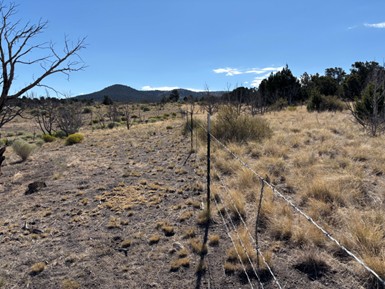
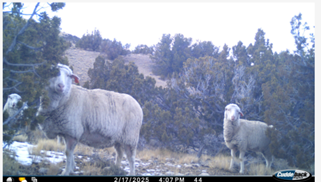
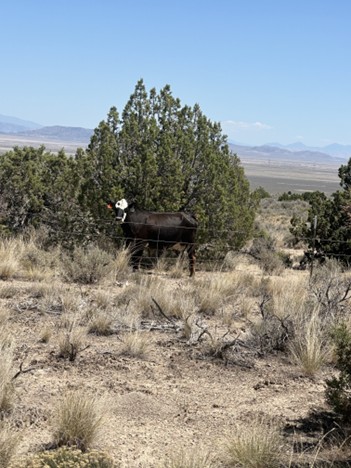
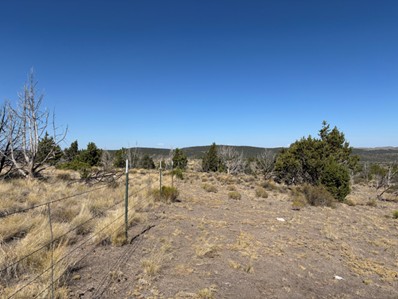
Additionally, most plots are fenced on grazed lands, allowing us to make grazed and ungrazed comparisons. We have prior data in grazed areas on PJ sites for 2006-2014 and are investigating differences in soil surface characteristics and plant communities between grazed and ungrazed areas. Furthermore, we commenced resampling four sites inside and outside exclosures in 2025. These datasets allow us to:
- Determine changes in forage production over 20 years after fuel treatments.
- Evaluate long-term effects of livestock grazing on soil and plant properties, including plant invasion.
Understanding the tradeoffs among fuel reduction techniques will assist managers and livestock operators in determining the best treatments for a particular landscape to reduce annual grass invasion and associated wildfire risk.
Latest Resources on Grazing
View article.
Cattle herbivory, a novel disturbance and selective force, was a significant component of two overlapping stress gradients most strongly associated with observed shifts in interactions. Facilitation and competition were strongest and most frequent at the highest and lowest stress levels along both gradients, respectively. Contrasting ecological optima among native and non-native beneficiaries led to strikingly different patterns of interactions. The four native bunchgrasses with the strongest competitive response abilities exhibited the strongest facilitation at their upper limits of stress tolerance, while the two non-natives exhibited the strongest competition at the highest stress levels, which coincided with their maximum abundance. Artemisia facilitation enhanced stability at intermediate stress levels by providing a refuge for native bunchgrasses, which in turn reduced the magnitude of B. tectorum invasion. However, facilitation was a destabilizing force at the highest stress levels when native bunchgrasses became obligate beneficiaries dependent on facilitation for their persistence. B. tectorum dominated these communities, and the next fire may convert them to annual grasslands.
View article.
Cold desert shrublands occur over strong environmental gradients and exhibit significant differences in resilience and resistance. They provide an excellent opportunity to increase our understanding of these concepts. Herein, we examine a series of linked questions about (a) ecosystem attributes that determine resilience and resistance along environmental gradients, (b) effects of disturbances like livestock grazing and altered fire regimes and of stressors like rapid climate change, rising CO2, and N deposition on resilience and resistance, and (c) interacting effects of resilience and resistance on ecosystems with different environmental conditions. We conclude by providing strategies for the use of resilience and resistance concepts in a management context. At ecological site scales, state and transition models are used to illustrate how differences in resilience and resistance influence potential alternative vegetation states, transitions among states, and thresholds. At landscape scales management strategies based on resilience and resistance-protection, prevention, restoration, and monitoring and adaptive management-are used to determine priority management areas and appropriate actions.