
Fuel Loadings
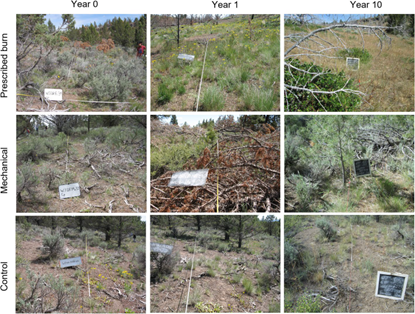
All aboveground plant material is flammable, and we measure this fuel through time to see how fuels accumulate after treatment. In the shrubland network, both prescribed fire and mechanical treatments reduced fuel loads at 10 years after treatment, resulting in reduced potential for high intensity wildfire. In the woodland network, however, fuels recovered more quickly. The increase in herbaceous fuels actually increases the potential for surface fire in the short term, but prevents the risk of fire moving through the woodland canopy.
Latest Resources on Fuels
View synthesis.
Our review revealed tradeoffs in woody fuel treatments between reducing canopy fuels vs. increasing understory herbaceous vegetation (fuels) and fire behavior. In pinyon-juniper expansion areas, all treatments decreased crown fire risk. Prescribed fire and cut and broadcast burn treatments reduced woody fuels long-term but had higher risk of invasion. Mechanical treatments left understory vegetation intact and increased native perennial plants. However, cut and leave treatments increased downed woody fuel and high-intensity wildfire risk, while cut and pile burn and mastication caused localized disturbances and annual grass invasion. Ecological outcomes depended on ecological resilience; sites with warm and dry conditions or depleted perennial native herbaceous species experienced lower recovery and resistance to invasive annual grasses. In invasive annual grass dominated areas, high-intensity targeted grazing reduced fine fuels but required retreatment or seeding; in intact ecosystems with relatively low shrub cover, dormant season targeted grazing reduced fine fuel and thus fire spread. Preemergent herbicides reduced annual grasses with differing effects in warm and dry vs. cool and moist environments.
View article.
Sagebrush ecosystems of western North America are threatened by invasive annual grasses and wildfires that can remove fire-intolerant shrubs for decades. Fuel reduction treatments are used ostensibly to aid in fire suppression, conserve wildlife habitat, and restore historical fire regimes, but long-term ecological impacts of these treatments are not clear. In 2006, we initiated fuel reduction treatments (prescribed fire, mowing, and herbicide applications [tebuthiuron and imazapic]) in six Artemisia tridentata ssp. wyomingensis communities. We evaluated long-term effects of these fuel treatments on: (1) magnitude and longevity of fuel reduction; (2) Greater Sage-grouse habitat characteristics; and (3) ecological resilience and resistance to invasive annual grasses. Responses were analyzed using repeated-measures linear mixed models. Response variables included plant biomass, cover, density and height, distances between perennial plants, and exposed soil cover. Prescribed fire produced the greatest reduction in woody fuel over time. Mowing initially reduced woody biomass, which recovered by year 10. Tebuthiuron did not significantly reduce woody biomass compared to controls. All woody fuel treatments reduced sagebrush cover to below 15% (recommended minimum for Greater Sage-grouse habitat), but only prescribed fire reduced cover to below controls. Median mowed sagebrush height remained above the recommended 30 cm. Cheatgrass (Bromus tectorum) cover increased to above the recommended maximum of 10% across all treatments and controls. Ecological resilience to woody fuel treatments was lowest with fire and greatest with mowing. Low resilience over the 10 posttreatment years was identified by: (1) poor perennial plant recovery posttreatment with sustained reductions in cover and density of some perennial plant species; (2) sustained reductions in lichen and moss cover; and (3) increases in cheatgrass cover. Although 10 years is insufficient to conclusively describe final ecological responses to fuel treatments, mowing woody fuels has the greatest potential to reduce woody fuel, minimize shrub mortality and soil disturbance, maintain lichens and mosses, and minimize long-term negative impacts on Greater Sage-grouse habitat. However, maintaining ecological resilience and resistance to invasion may be threatened by increases in cheatgrass cover, which are occurring regionally.
View article.
Over the past century, pinyon and juniper trees have encroached into sagebrush steppe lands of the interior United States, and managers have for many years removed trees to stimulate the favored understory. While consistent understory response to tree removal in these semiarid lands suggests that trees outcompete other plants for water, no studies have linked increased soil water to understory response after tree removal. We tested the hypothesis that tree removal at six sagebrush steppe sites increased soil water, leading to increased understory plant cover. Using a structural equation model, we found that before tree removal, trees suppressed shrubs (standardized coefficient [SC] = −0.87), perennial deep-rooted (SC = −0.50) and shallow-rooted bunchgrasses (SC = −0.36), but had no influence on cheatgrass. The model explained between 2% (cheatgrass) and 40% (shrubs) of pretreatment cover variation. Measurement of the same plots six years post-treatment showed that most cover variation was due directly to plant growth, with standardized coefficients between 0.51 (perennial shallow-rooted grasses) and 0.72 (cheatgrass). Competition between cheatgrass and perennial deep-rooted grasses was evident, with perennials having twice the influence on cheatgrass than vice-versa (SC = −0.24 vs. −0.11). Spring soil water (wet-degree days) increased significantly after tree removal, measured as cumulative over 6 years (SC = 0.30), and in the early Spring of year six (SC = 0.16). Treatment-induced increase of cumulative Spring wet degree-days explained variation in shrub cover at year 6 (SC = 0.12) and the increase of early Spring wet degree-days at year 6 led to increases in perennial deep-rooted grasses (SC = 0.24) and cheatgrass (SC = 0.23). We detected no influence of Spring wet degree-days on perennial shallow-rooted grasses. The post-treatment model explained between 34% (shallow-rooted perennial grasses) and 69% (deep-rooted perennial grasses) of variation in understory cover. Most variation was explained by re-measurement of the same populations, followed by treatment effects mediated through increased soil water availability, soil factors, and direct effects of the treatment itself. In conclusion, our model is consistent with the a priori hypothesis that additional wet degree-days due to tree removal is a significant mechanism behind observed increases in understory cover.