
Wildfire
Almost half of the SageSTEP plots have experienced complete or partial burning from wildfires since initial project treatments were implemented. This provides an opportunity to understand whether fuel treatments resulted in differential fire behavior, fire effects, and post-fire recovery
Latest Resources on Fire
View synthesis.
Our review revealed tradeoffs in woody fuel treatments between reducing canopy fuels vs. increasing understory herbaceous vegetation (fuels) and fire behavior. In pinyon-juniper expansion areas, all treatments decreased crown fire risk. Prescribed fire and cut and broadcast burn treatments reduced woody fuels long-term but had higher risk of invasion. Mechanical treatments left understory vegetation intact and increased native perennial plants. However, cut and leave treatments increased downed woody fuel and high-intensity wildfire risk, while cut and pile burn and mastication caused localized disturbances and annual grass invasion. Ecological outcomes depended on ecological resilience; sites with warm and dry conditions or depleted perennial native herbaceous species experienced lower recovery and resistance to invasive annual grasses. In invasive annual grass dominated areas, high-intensity targeted grazing reduced fine fuels but required retreatment or seeding; in intact ecosystems with relatively low shrub cover, dormant season targeted grazing reduced fine fuel and thus fire spread. Preemergent herbicides reduced annual grasses with differing effects in warm and dry vs. cool and moist environments.
View article.
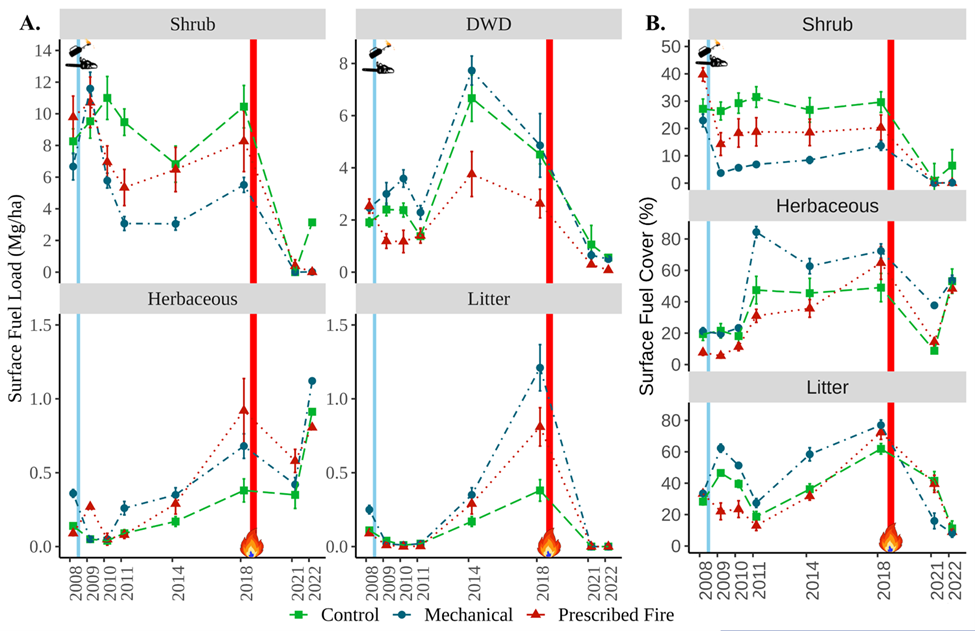
Increased herbaceous surface fuel following prescribed fire treatments increased the modeled rate of surface fire spread (ROS) 21-fold and nearly tripled fame length (FL) by year ten post-treatment across all expansion phases. In mechanical treatments, modeled ROS increased 15-fold, FL increased 3.8-fold, and reaction intensity roughly doubled in year ten post-treatment compared to pretreatment and untreated controls. Treatment effects were most pronounced at 97th percentile windspeeds, with modeled ROS up to 82 m min−1 in mechanical and 106 m min−1 in prescribed fire treatments by 10 years post-treatment compared to 5 m min−1 in untreated controls. Crown fire transmissivity risk was eliminated by both fuel treatments. While prescribed fire and mechanical treatments in shrublands experiencing tree expansion restored understory vegetation and prevented continued juniper and pinyon infilling and growth, these fuel treatments also increased modeled surface fire behavior. Thus, management tradeoffs occur between desired future vegetation
and wildfire risk after fuel treatments.
View article.
Increased fire size and frequency coupled with annual grass invasion pose major challenges to sagebrush ecosystem conservation, which is currently focused on protecting sagebrush community composition and structure. A common strategy for mitigating potential fire is to use fuel treatments that alter the structure and amount of burnable material, thus reducing fire behavior and creating access points for fire suppression resources. While there is some recent information on the impacts of fuel treatments on ecological communities, we have little information on fuel treatment effectiveness at modifying fire behavior in sagebrush ecosystems. We present 10 years of data on fuel accumulation and the resultant modeled fire behavior in prescribed fire, mowed, herbicide (tebuthiuron or imazapic), and untreated control plots in the Sagebrush Treatment Evaluation Project (SageSTEP) network in the Great Basin, USA. Fuel data (i.e., aboveground burnable live and dead biomass) were collected in each treatment plot at Years 0 (pretreatment), 1, 2, 3, 6, and 10 posttreatment. We used the Fuel and Fire Tool fire behavior modeling program to test whether treatments impacted potential fire behavior. Prescribed fire initially removed 49% of the total fuel load and 75% of shrubs, and fuel loads remained reduced through Year 10. Mowing shifted fuels from the shrub canopy to the ground surface but did not change the total fuel amount. Prescribed fire and mowing increased herbaceous fuel by the second posttreatment year and that trend persisted through Year 10. Tebuthiuron treatments were ineffective at altering fuel loads. Imazapic suppressed herbaceous vegetation by 30% in Years 2 and 3 following treatment. The modified fuel beds in fire and mow treatments resulted in modeled flame lengths that were significantly lower than untreated control plots for the duration of the study, with shorter term reductions in reaction intensity and rate of spread. Understanding fuel treatment effectiveness will allow natural resource managers to evaluate trade-offs between protecting wildlife habitat and reducing the potential for high-intensity wildfire.