
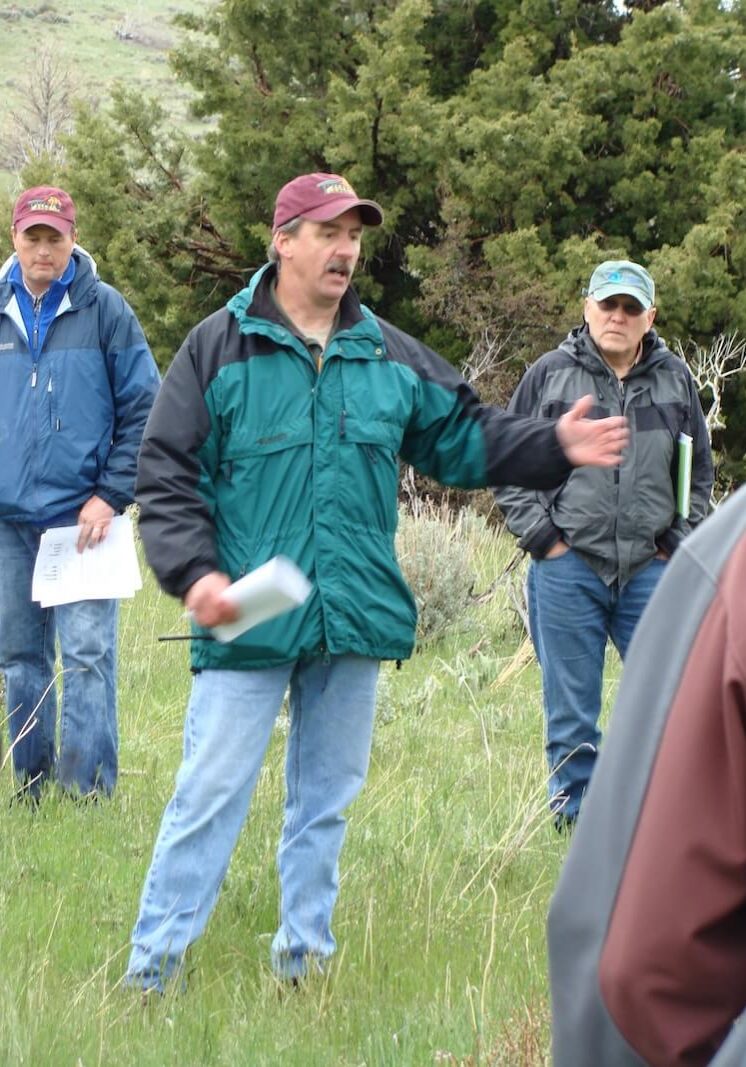
Fred Pierson_Reynolds Creek_Breaks Rx burn

Citizens' and Managers' Perspectives

Each of the management options we are evaluating is potentially controversial and could be opposed by some citizens or managers for use on public lands. Even when science suggests that certain management actions will benefit the land, resistance from citizens' groups can make it difficult to take such actions in all of the places where they might be beneficial.

To help managers understand the societal environment in which sagebrush-steppe restoration will take place, we are studying the acceptability of our experimental treatments to various rangeland constituencies as well as to citizens generally. We will also explore how citizens' judgments and legal/regulatory factors affect land managers' decisions about fuels reduction and sagebrush ecosystem restoration.

This research is designed to address the following questions:

  • How do key stakeholder groups assess tradeoffs associated with alternate approaches to restoration? [more...]
  • How do citizens generally judge acceptability of alternate approaches to restoration? [more...]
  • What institutional factors (laws, regulations, policy statements, etc.) are likely to influence managers’ decisions whether to propose alternate treatments?
  • How do grazing permittees assess tradeoffs associated with alternate approaches to restoration on public lands?
  • What differences exist in the understandability, credibility, and helpfulness of various methods for communicating about alternate approaches to restoration?
  • How do citizens judge the acceptability of alternate approaches to restoration after having observed the progress of those approaches?

Publications related to the sociopolitical research can be found on our SageSTEP Publications page.

Latest Resources on Human Perspectives

Acceptance, acceptability, and trust for sagebrush restoration options in the Great Basin: A longitudinal perspective

View article.

In surveys of residents in three urban and three rural locations in the Great Basin we examined the social acceptability of six management practices showing promise for restoring sagebrush-dominated rangelands. Unlike most studies of range management perceptions that have relied on single measurements, we used longitudinal data from a questionnaire mailed in 2006 to residents that were resurveyed in 2010. Overall, 698 respondents comprised the panel. Respondents’ self-reported levels of knowledge about the health and management of Great Basin rangelands decreased from 2006 to 2010. In both years, mean acceptance was greater for the use of prescribed fire, grazing, felling, and mowing, but relatively low for chaining and herbicide use. Overall, acceptability ratings were similar in 2006 and 2010 but individually about half of the acceptance responses differed between years. Practices were more acceptable to respondents who expressed greater concern about threats posed by inaction, except that the threat of wildfire was negatively associated with acceptance for prescribed burning. Acceptance was not significantly related to concern about overall health of Great Basin rangelands, or to self-reported knowledge level. Rural/urban residence and general attitudes toward environmental protection were sometimes influential, but more so in 2006 than in 2010. By far the best predictor of acceptance was trust in agencies’ ability to implement the practice. In both years respondents were more likely to judge a practice acceptable than to trust agencies to use the practice. Positive or negative change in trust level was the most significant predictor of change in acceptability judgment from 2006 to 2010. Results suggest that efforts to increase acceptance of practices among Great Basin stakeholders should focus on activities designed to build trust rather than simply providing more or better information.

The economics of fuel management: Wildfire, invasive plants, and the dynamics of sagebrush rangelands in the western US

View article.

In this article we develop a simulation model to evaluate the economic efficiency of fuel treatments and apply it to two sagebrush ecosystems in the Great Basin of the western United States: the Wyoming Sagebrush Steppe and Mountain Big Sagebrush ecosystems. These ecosystems face the two most prominent concerns in sagebrush ecosystems relative to wildfire: annual grass invasion and native conifer expansion. Our model simulates long-run wildfire suppression costs with and without fuel treatments explicitly incorporating ecological dynamics, stochastic wildfire, uncertain fuel treatment success, and ecological thresholds. Our results indicate that, on the basis of wildfire suppression costs savings, fuel treatment is economically efficient only when the two ecosystems are in relatively good ecological health. We also investigate how shorter wildfire-return intervals, improved treatment success rates, and uncertainty about the location of thresholds between ecological states influence the economic efficiency of fuel treatments.

Economic risks of cheatgrass invasion on a simulated eastern Oregon ranch

View article.

The potential of invasive plants to alter fuel properties over time has implications for the ranchers of semiarid rangelands throughout the world. A prime example of this phenomenon is the cheatgrass invasion of the native shrub-steppe lands in Great Basin of the western United States. The purpose of this study is to develop a bioeconomic model that optimizes simulated ranch behavior given the beginning stages of cheatgrass invasion on a public forage allotment. The bioeconomic model is applied to a typical eastern Oregon 300 cow-calf ranch. Livestock production decisions are simulated over a 40-yr planning horizon using a multiperiod linear programming model. Results showed changes in profit-maximizing ranch management strategies in the form of decreased optimal stocking rates and forage substitution. The net present value of the simulated ranch’s income stream declined, and the probability that the ranch cannot meet its full costs of livestock production and would exit the industry increased as a result. These economic impacts were more pronounced with decreased sale price. Sensitivity analysis showed that overall results in terms of ranch behavior were specific neither to the assumed discount rate nor to the assumed percentage of cheatgrass cover (as long as this percentage is within the reference state) on the public grazing allotment. This study introduces a method for managers to quantify impacts on ranches from fuel-altering invasive plants on public lands, emphasizing the importance of including information about native and invasive forage production characteristics and wildfire frequency as a function of the state of invasion.